Pictures: Paulo Pepe/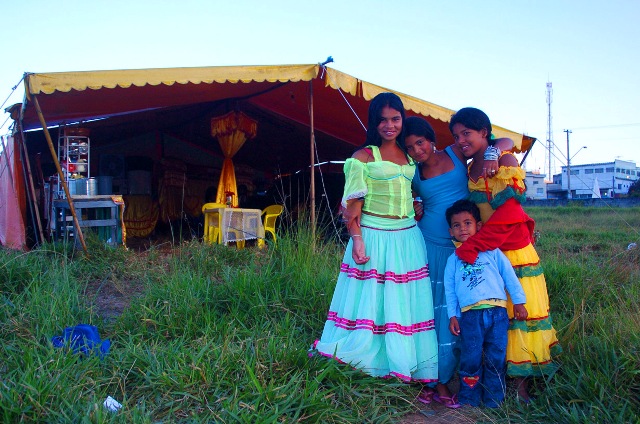
On the outskirts of São Paulo, it’s easy to miss the orange tents amid the tufts of grass in Itaquaquecetuba from the whirl of the freeway. But with a closer look, a Gypsy camp shows its colours: a dozen or so tents with embroidered pieces of fabric hung on improvised walls.
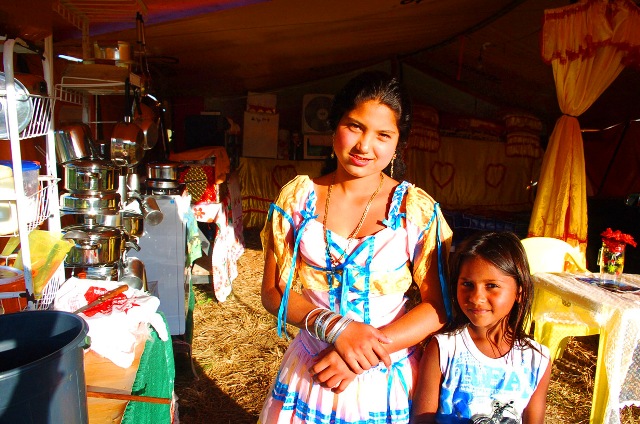
Inside the tents, women wearing long, lively dresses squat on the dirt floors to drink their coffee. They meld with the patchwork of shiny pans, bunk beds, high-tech TVs and sound systems. They just arrived from the city centre, where they go everyday to read people’s palms.
“Our days are hard. People run away from us, they are scared. Sometimes we get 10, 12 dollars a day”, says Elizete de Cardoso, the camp chief’s wife.
Like thousands of Gypsy, or Roma camps – as they prefer to be called – in Brazil, they have no electricity or water, even though the families have been living there for over 20 years. There are no toilets or sanitation: all 100 people use a corner hidden behind an abandoned building.
The living conditions are basic. Yet, they preserve the same lively lifestyle that was passed on over generations. According to expert Frans Moonen, the majority of the Brazilian Roma do not lead nomad lives anymore, but other traditions remain intact.
The Romani language, for instance, is still spoken amongst them. Kids still engage in arranged marriages when they are 13 to 15 years old.
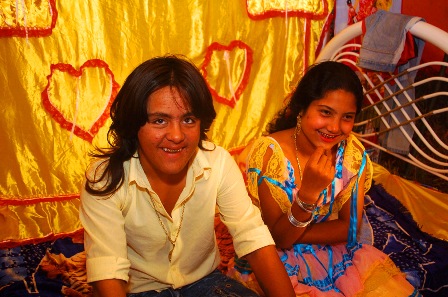
To the recently married couple Luana Ferreira, 14-years-old, and Djavan Pereira, 15-years-old, life is “ok” in their brand new tent. “Married life is good”, she says blushing.
One of the few men to keep a traditional occupation is a weathered looking Roma wearing a baseball cap. Claudinei Pereira still does leatherwork. “I design horse saddles and carriage reigns. People come from all around to buy from me. My grandpa used to work with this”.

But unlike old-times, when the men used to trade horses, nowadays the main goods are used cars, often unlicensed. “We sell and exchange cars, used goods, and equipment from Paraguay”, says Euclides Ferreira, the camp’s chief, revealing a glimmer of gold through his smile.
They decided to stick with this campsite because better ones are growing scarcer. “We are not welcome in many places. When you put up your tent, city council officers come to throw you out”, explains Claudinei Pereira. Only a few local administrations in Brazilian cities provide land for the Roma. In many places, like here in Itaquaquecetuba, they live on private land, and risk being thrown off at anytime.
While we speak, little girls in colorful dresses run to and fro. Very few of them have ever been to school. The government estimates that 90% of the Roma living in camps are illiterate. Mr. Pereira had to put up a fight to get his eldest kid into school. “When I went to schools and told them I was a gypsy, nobody wanted to help me, they said there were no vacancies”.
Problems aren’t new to the Roma. The first of them to arrive in Brazil were deported from Portugal between the 16th and 18th centuries. Once in Brazil, their language was forbidden; they were persecuted by local governments; and were expelled from town to town. In the 1700s, some towns in the state of Minas Gerais even requested their citizens to detain any Roma and keep whatever goods they were carrying.
That’s why many still carry the mark of marginalization. Several do not even have a birth certificate. That means they do not have proof of identification. To the State, they do not exist.
This history of negligence still has consequences today, according to Yáskara Guelpa, a Roma representative in the National Commission of Traditional Communities. “The health and education professionals must learn about us because there is huge prejudice. For instance, if a gypsy girl goes to school with a long skirt, the teacher does not understand and asks her to use pants – and that is against our culture”.
On the other hand, the State admittedly lacks crucial information about this minority. There has never been a national survey on how many Roma there are in Brazil, or how they live. Independent estimates vary from 250 thousand to one million.
“It’s a big problem”, admits the national Sub-secretary of Human Rights Promotion, Perly Cipriano. “No state or council knows how many gypsies live within their limits”. According to him, the government has requested the National Institute of Geography and Statistics to include the Roma in the next census.
In many cases, the only State presence in the camps is though police intervention. Father Rocha, a priest of the catholic organization Pastoral of the Nomads, has lived in many Roma camps and has witnessed repeated scenes of police abuse.
“The police do not recognize that the Roma tent is their home and therefore is inviolable according to the Constitution. They descend into the camps aggressively, kicking the pans that are on the fire, shouting at people”, he says.
He claims to have stepped forward countless times to avoid arbitrary detentions and police extortion. “I wish I had studied law to stop police extortion. When they find an undocumented car for instance, they ask for 10 thousand dollars and the men have to find a way to get it. Once in a camp in Espírito Santo I protested and was handcuffed”, he says.
But not all the Brazilian Roma are nomads or poor. Many of those who came with the European immigrants in the beginning of the 20th century are now wealthy and integrated into society. Yáskara Guelpa for instance is a successful journalist who lives in an expensive house in a middle-class neighbourhood in São Paulo. But like many other upper and middle-class Roma, she prefers to hide her identity. “I don’t go around speaking out about this. The prejudice is still too strong”.
Circus teacher Adriana Sbano, who belongs to a traditional circus family, also feels forced to hide her culture. “I work at upper-class schools in São Paulo and simply keep quiet, because one can not know what the reaction will be. I can’t risk loosing my job”, she says. Brazil’s circus history can be traced to the Roma, and even today many are run by them. But according to Adriana, many prefer to deny their origin for fear of prejudice.
Only recently have some upper-class Roma come out of hiding. The musician Wagner Tiso and the popular comedian Dedé Santana admitted their lineage in public. The Biology professor in the State University of Feira de Santana Jucelho Dantas da Cruz is one of the few who have never lied about his identity. “Even though some students find it strange, I am a Roma in heart and soul. It would be a crime to deny my origin”.
Government initiatives in the last couple of years have also helped shed light on the issue.
In 2006, a presidential decree established May 24 as National Roma Day, recognizing this ethnic group as an important element to the Brazilian identity. After all, Brazil is one of the few countries that has ever had a president of Roma lineage, Juscelino Kubitchek, who founded the capital Brasilia in 1963. But he has never admitted to be so.
In 2008, the Ministry of Culture established an annual prize for initiatives that preserve, recover and disseminate the Roma culture.
At the same time a guide to the rights of this minority was released. Written by a Roma lawyer, Mirian Stanescon, it tells the history of this minority in Brazil and details their rights. Since then it has been distributed at meetings in various communities. It is a way to show Roma they are not alone anymore, according to Mirian Stanescon.
Still, many activists complain that there is no public policy that can actually change the situation of the impoverished Roma. To Yáskara Guelpa, many of their demands are still to be met. “The main issues are access to education and permanence in the schools, access to health, and social inclusion. And we want all cities where there are Roma camps to provide land with water and electricity. That’s all.”
To sub-secretary Perly Cipriano, addressing Roma’s issues is still a huge challenge. But he believes the policies are moving forward, even if slowly, since no government has never done anything for this minority.
Ms Guelpa agrees: “With all the problems and mistakes, we must admit that this government has opened the doors for Roma people to say: ‘We exist.’ ”.

What do you think?